Tempesta Technologies
  • Home
  • Tempesta FW
    • Features
      • Web acceleration
      • Load balancing
      • Application performance monitoring
    • Performance
    • How it works
    • Deployment
    • Support
    • Knowledge base
  • Services
    • Software development
      • High performance
      • Networking
      • Databases
      • Linux kernel
      • Machine learning
      • How we work
      • Case studies
    • Performance analysis
    • Network security
      • DDoS protection
      • Application security
      • Cryptography
      • Security assessment
      • How we work
      • Case Studies
  • Solutions
    • DDoS Protection
    • Web Acceleration
  • Blog
  • Company
    • Research
    • Careers
    • Contact
Tempesta Technologies

DDoS Protection

Fork me on GitHub

Open-Source DDoS Protection for High-Traffic Infrastructure

Stop volumetric and hybrid attacks on your own infrastructure — without traffic redirection, vendor lock-in, or added latency.

At Scale, Cloud Protection and Appliances Become Limiting Factors
You Need DDoS Protection You Control

Cost – cloud protection and appliances become prohibitively expensive at high traffic volumes
Dependency – availability depends on external providers and their decisions
Inflexibility – targeted attacks demand custom protection logic for specific applications
Big vendors = big targets – attackers bypass Cloudflare, Akamai & Ko to attack big companies, so all others are exposed at once
Compliance – regulated environments cannot pass traffic through third parties
tempesta_xfw_arch2_cropped
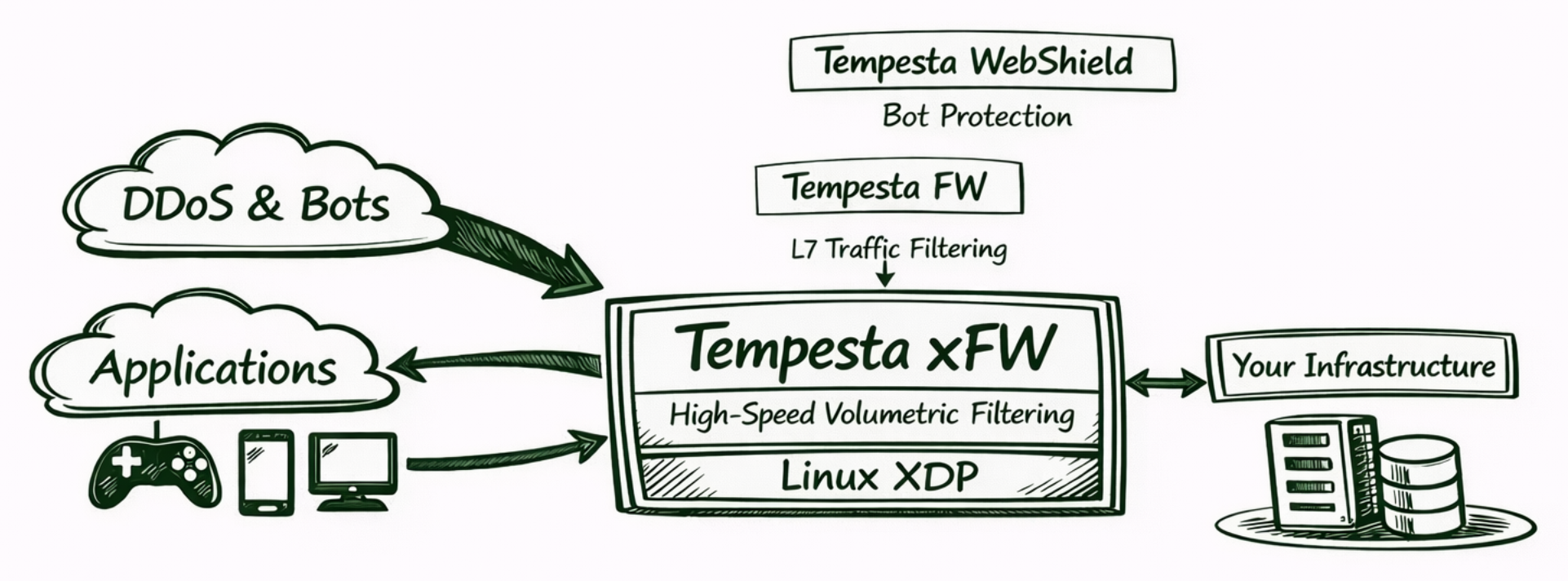
Tempesta® xFW is an extensible open-source volumetric DDoS protection platform.

No vendor lock-in.
No black-box logic.
Full control.

icon_httpTables-2024

eBPF-based Volumetric DDoS Protection

Tempesta xFW is open-source suite of Linux XDP and TC eBPF modules for volumetric DDoS protection. Its layered filtering architecture efficiently blocks both large-scale volumetric attacks and hybrid attacks.

Reliability

Tempesta xFW uses Linux eBPF programs, which undergo strict kernel verification and provide high reliability with years of uptime. Tempesta xFW has been proven in production for volumetric DDoS protection.

A typical alternative to eBPF is DPDK, including VPP. These are user-space C/C++ applications that may crash because of software bugs, leading to loss of protection or even failure of the entire data plane.

Performance

Tempesta xFW works on standard x86-64 servers and supports multi-port 200Gbps and higher NVIDIA or Intel adapters. CPU and power consumption scale with traffic volume, and you can run other applications, such as HTTP or DNS servers, on the same host as Tempesta xFW.

This differs from DPDK-based approaches, which may deliver higher peak performance but typically consume all available CPU resources and do not allow application services to run on the same host.

ECMP setups can be used to scale to 1 Tbps and beyond.

icon_CDN

Deployment Architectures

Tempesta xFW can be deployed either in pass-through (inline) mode or in redirection (out-of-path) mode. It can operate as always-on or on-demand scenarios. In on-demand and/or redirection deployments, it can be integrated with a DDoS detection sensor.

Redirection
In a redirection architecture, an edge router sends sampled telemetry to a DDoS detection sensor, which reconfigures the router to redirect traffic for scrubbing when an attack is detected.
This strategy typically introduces some detection latency between the start of an attack and the application of redirection rules. During that interval, the infrastructure remains exposed. However, many hosting and service providers use this approach for several reasons:
  • It allows mitigation resources to be shared across multiple edges
  • It reduces the blast radius for unaffected customers
  • Filtering logic, even with no active rules, still adds some latency, whereas this approach adds no latency to normal traffic
  • If the DDoS protection system fails for any reason, the main data plane continues to operate

Modern DDoS attacks, such as Aisuru-Kimwolf, can exploit this architecture with a hit-and-run strategy: the attack may last only for 20 to 60 seconds, leaving too little time for the detection system to apply rules and block it.

Inline always-on

An inline always-on deployment may add unwanted packet-processing latency to normal traffic and is typically less cost-efficient than a redirection-based filtering architecture.

However, low detection latency is crucial for mitigating modern DDoS attacks. Inline always-on filtering can completely eliminate detection latency for some attack types, such as malformed-packet attacks, or reduce it to the millisecond range.

The drawback of this architecture is that false positives may affect legitimate traffic even when no attack is in progress.

Hybrid

Tempesta xFW can operate in a hybrid mode that combines the benefits of redirection and inline always-on architectures while reducing their drawbacks.

In this architecture, the base deployment is inline. Only a small subset of reliable rules, such as permissive rate limits, is enabled in always-on mode. These rules have almost no impact on packet-processing latency, while still filtering a large share of traffic from hyper-volumetric attacks.

A more advanced rules set, such as TCP anomaly filter, is enabled by a DDoS detection sensor and filters the remaining parasitic traffic that passes through the first layer of always-on rules.

icon_security

L3-L7 Protection

Tempesta xFW supports filtering DDoS attacks across all network layers:

  • IPv4, IPv6, ICMPv4, ICMPv6,
  • TCP, UDP, GRE
  • DNS
  • HTTPS, HTTP/2 (with Tempesta FW)
icon_edge

DNS Protection

Tempesta xFW protects DNS servers against DNS attacks, including DNS and UDP floods, and also prevents them from being abused as reflectors in reflection and amplification attacks.

icon_web-300×300

Web and API Protection

Protection of web resources using HTTPS, HTTP/2 and HTTP/3 (QUIC) against TCP and UDP floods. Tempesta FW can be deployed on the same host as an already running web server or proxy. It automatically learns active TCP flows and blocks garbage packets unrelated to known or newly established legitimate TCP flows.

icon_WAF

Observability

Traffic counters are exported in Prometheus format for seamless integration with monitoring solutions.

All blocking events can be written to ClickHouse database using efficient zero-copy transport.

icon_networking

Host and Network Protection

Tempesta xFW supports both host and gateway deployment modes.

In host mode, it runs on the same machine as the protected web, DNS or other service. The typical use cases are an HTTP load balancer and a DNS server.

In gateway mode, it runs as a Linux router protecting entire networks. The typical use cases are ISP scrubbing and corporate network protection.

icon_monitoring-2024

Automatic Incident Reporting

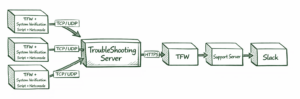
Tempesta Escudo is the commercial edition of Tempesta xFW. It includes automatic incident reporting allowing our team to be notified in Slack as soon as an incident occurs on one of your servers.

No support tickets or emails are required. The relevant diagnostic data is collected automatically, so we can start investigating immediately.

Data collection scripts are shipped as source code, so you remain in control of what information is shared externally.

escudo_troubleshooting_arch
icon_bot-1-2024

Full-Stack DDoS and Bot Protection

Tempesta xFW can be integrated with Tempesta FW and Tempesta WebShield to provide full-stack protection against volumetric L3/L4 attacks, application-layer L7 DDoS attacks, and unwanted bots.

Tempesta WebShield analyzes Tempesta FW access logs to learn normal user behavior and detect web scrapers, carting and checkout abuse, inventory scraping, security scanning, L7 DDoS attacks, and other advanced bot activity.

Watch our FOSDEM’26 talk to learn more.
icon_deployment

Deployment

arrow1

Evaluation mode provides a safe way to assess system behavior and mitigation effectiveness on production traffic without affecting legitimate user traffic.

arrow2

Tempesta xFW can be deployed in cloud environments, including Docker and Kubernetes, as well as on bare metal and virtual machines, including KVM-based deployments.

arrow1

Tempesta xFW can be installed from prebuilt packages. System requirements are available in our Wiki.

icon_whyus

Commercial Support and Custom Development

Our team provides commercial support and custom development services for Tempesta xFW, FW and WebShield:

arrow2

Aarchitecture and performance review, plus consulting on securing target applications

arrow1

Deployment design and assistance with Tempesta xFW installation and configuration on your servers

arrow2

incident analysis and real-time support during attacks

arrow1

custom extensions for specific environments and workloads, such as gaming, available under commercial terms

arrow2

Please contact us for any inquiries.

icon_howwework

Tempesta xFW Knowledge Book

Powered by Tempesta FW

Stay up to date with our latest developments

Useful Links

Home
Blog

Tempesta® FW

Features
Performance
Deployment
Support
Knowledge Base

Services

Software Development
Performance analysis
Network Security

Solutions

DDoS Protection

Web Acceleration

Company

Research
Careers
Contact